Hello to all! How about your life?
In my case, I been gone a long time. I was not able to write more articles about the world of llamas and alpacas (South American camelids) for some personal reasons.
But that is long gone, I am trying to find time to show you this fascinating world.
One of my goals is search information to be public and useful to anybody who look learning, or maybe, breeding this animals.
Let's start with the right foot!
Sunday, May 25, 2014

Friday, March 1, 2013
Diarrhea in calves, part 2
Prevention and control of communicable diseases
1. to prevent enterotoxemia is recommended:
- Ensure that the calf is born, take the colostrum or first milk Redeemer of the first hours after birth, to acquire resistance to disease.
- Ensure that the offspring take clean water and power, and avoid stagnant water ingestion.
- Select in advance the tennis pair calving, so that mothers eat well, to produce enough milk for ences
- Ensure that the roosts are dry and slightly inclined to the formation of muddy evirar.
- Practice roosts rotation whenever they are dirty or puddles.
- Perform rotation grazing fields
2. For diarrhea atypical recommended:
- Ensure that the hatchlings make their colostrum within the first few hours after birth and breastfeeding ensure iaria.
- Use clean, dry pens
- Select fields with good pasture calving, for mothers to eat well and to produce enough milk for the young.
3. Coccidiosis is recommended for:
- Ensure the suction of colostrum by calves during the first hours after birth
- Ensure that the offspring take clean water supply.
- Ensure use of roosts clean and dry.
Treatment
- In the case of enterotoxemia, effective treatment can be achieved if the time to detect onset of the disease and can be used for this antibiotic. As treatment can be used sulfaro paleativo magnesium dissolved in warm water if laenfermedad have time to his administration, which will cause the expulsion of toxins together with intenstinal content.
- In the case of atypical diarrhea, immediate treatment is changing roosts and use of oral antibiotics
- In the case of coccidiosis, once the disease has diagnosicado, relaiconado symptoms with the observation of gross lesions of the intestines and colo of diarrhea in calves, immediately treat all Rias preferably with sulfa.

Prevention and control of the disease
- Practice rotation grazing fields.
- Ensuring good alimentaion of animals, keeping the flock only necessary, according to the quality and catidad grassland that has, thus avoiding overcrowding.

Diarrhea in calves, part 1
Diarrhea in baby alpaca
The pup mortality in the hood of calving is a serious problem in alpaca breeding, hence the constant concern dwe producers find alternatives but simple techniques aplicaion.

A confunsion on the type of disease being treated, and how they can be controlled, because CIRAS die a week or a month, and other times they die several offspring simultaneously, which confuses the breeder.
Those who produce diarrhea
The bacteria or "germs" and parasites that cause diarrhea are:
- Welchie Clostridium (bacteria) causes enterotoxemia.
- Escherichia coli (bacteria) causes diarrhea atypical
- Coccidia (parasite) that cause coccidiosis.
These can only verese under the microscope.
Symptoms of the disease
1. When it comes to the most notorious enterotoxemia symptoms are:
- Calves are decayed, and cast away from his mother.
- Present the swollen belly and bid but not defecate
- Get plenty of water having fever.
- However, other die without showing any symptoms
- The disease generally occurs in wet years.
Externally, the belly is very swollen, as if about to burst. When opened, the intestines tend to escape due to the strong pressure of the gas contained in them, and the smell is perceived unpleasant characteristic.

- Persistent diarrhea with stools whitish, yellowish or greenish white, resulting in the cira puerda weight quickly.
Diarrhea may persist for several days (2-5 days), especially when they are kept in pens dirty and wet.
- Finally the CIRAS is weak, listless, and die cast remain.
- At necropsy, the most striking is the poor animal's meat condidiocn and intestinal content is fluid without the presence of gases.
3. When it comes coccidiosis presenting symptoms Calves are:
- Decay and lack of appetite
- General weakness and weight loss
- They have dark and persistent diarrhea
- Affects the offspring but are in good condition
- At necropsy is the thin intesitno bleeding.
All rights reserved to National Agricultural Research Institute, INIA - Peru. 2000
Saturday, February 16, 2013
Control Offspring, Part 2
We must do before activity
- Allocate a tennis grazing good pasture and water for pregnant females to calve.

- Clean the roosts and fix or build new ones so that the bell is taken from 2-3 roosts in operating conditions.
- Buy the iodine before the bell starts calving.
What should we do during the activity
- Ensure that the calving herd consists only of pregnant females and avoid encountering male players to eviar abuse or fights that could go against females.
- Disinfect the navel of the calf immediately after birth, carefully observe the cria is born to get up and take your normal colostrum within the first hours after birth.

What should we do after activity
- Observe strict observation for three days, the babies who are born, especially those who have had problems, to help whenever needed.
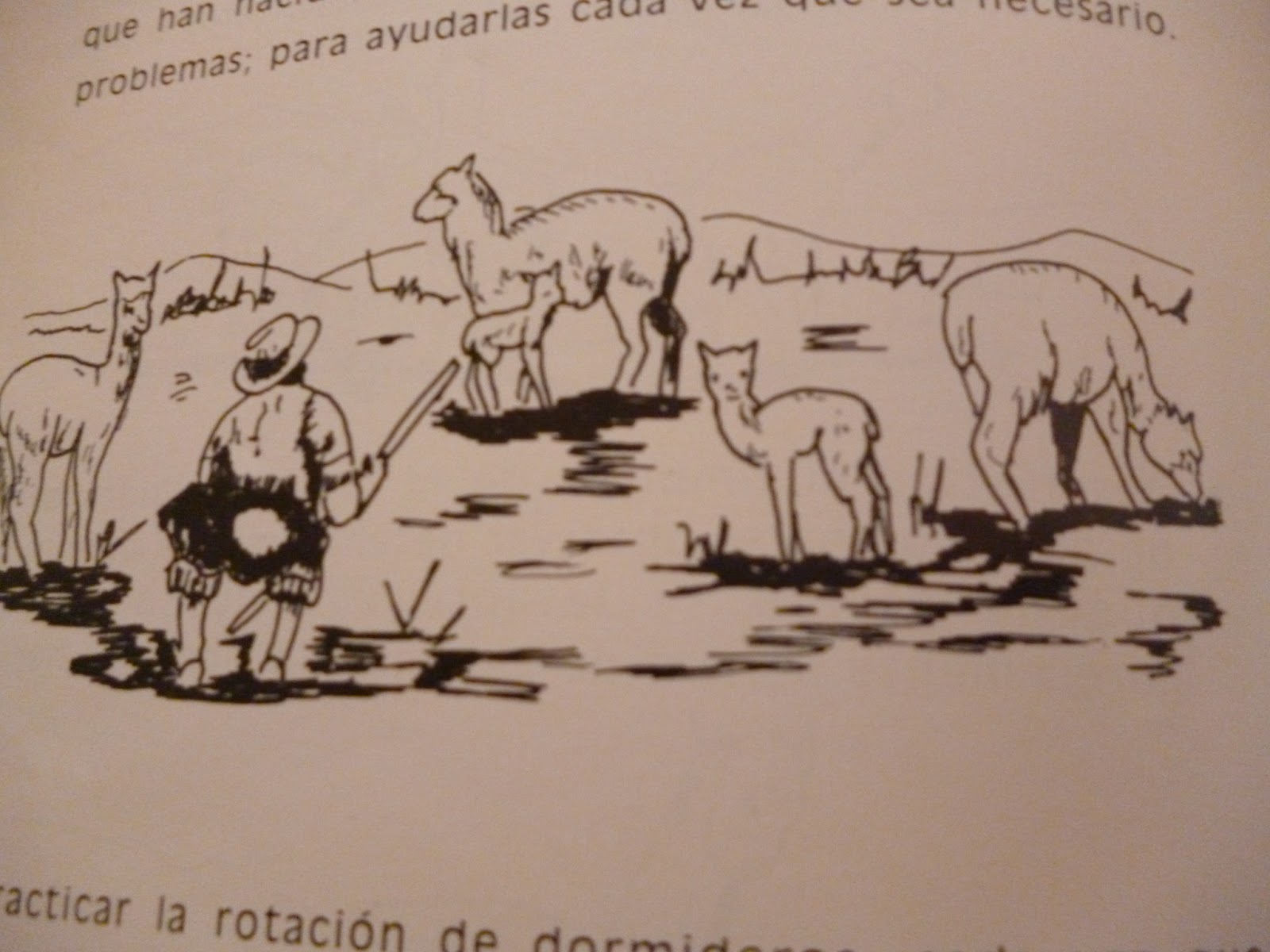
- Practice the rotation of roosts, whenever these are dirty or muddy.

Control Offspring, part 1
Preventive measures to lower mortality in offspring
- Preventive measures are simple application activities to be undertaken during the bell calving to ensure that the calf alive.

Main problems
- One of the major problems in raising alpacas at the community level is the high calf mortality within the first 3 months of life. 20, die about 10.

- Diarrhea and neumoticos processes are the most common diseases in offspring that are not treated promptly. Hatchlings dead dawn one day to the other.
- There is lack of knowledge about the importance of disinfecting the navel, timely consumption of colostrum and the advantages of roosting rotation, during the months of January to March.

What we do
It is necessary to implement the following:
a) Traskadar pregnant animals to pasture fields pastorearlas break during the last 3 months of gestation.
b) Ensure that the breeding take the first milk or colostrum within the first hours after birth.

c) Disinfect the navel with iodine hatchlings, wound healing and prevent entry of microbes that produce enfermeades.

Friday, February 1, 2013
The Scabies, part 3
Prevention and control of the disease
The baths must be scheduled and run 2 times a year, one in April and one in November after shearing, with their repetitions 12 days later.

Prevent the entry of animals suspected or scabies lesions in a healthy herd.

When practicing tratameiento tropical, like animals and repeat the same operation every 8 days, until healed completely, to prevent its spread.


The Scabies, part 2
Symptoms of the disease
It starts with itching in the area affected by the action of masticatory and sucking parasites, and because of this the animal is scratching, rubbing on fences, rocks or with their hind hooves

When the parasite acts in the ear, makes alpaca continuously move and shake your head at any moment. If not treated early, complications occur with other disease called otitis.

When lesions are located on the limb, hindering their displacement.
Finally down to condition animals because they can not alimnetarse normally through the hassle of itching that causes these parasites.
Disease Treatment
Once the disease has been detected in one or more animals, consider that all of them are affected, so the treatment chosen should be for the whole herd, alpacas, llamas and sheep.
May be considered for treatment in the following ways:
a) Baths pool by immersion in longitudinal
For this activity requires a vat, where animals enter one after another at one end, making them go deep in water containing antisarnico, then out the other end where the corral enceuntra drainer, here remain a time, and then take the field where drying finish.

Advantages:
- Allows bathe a large number of animals and effective when used according to the antisarnico the Product indicaicones
- Allows community organization.
Disadvantages:
- It is slow and can cause damage in some animals.
b) Treatment tropical
This is the easiest way to cure scabies, especially when few animals. Consists heavily diseased parts rub with a cloth dipped in the drug causing the product to penetrate deeply, to kill parasites.
Advantage:
- Allows family involvement.
Disadvantage:
- Requires a continuous treatment of sick animals, every eight days until healed.

c) Injection Treatment

Advantage:
- Also act against other internal and external parasites and requires no repetition.
The Scabies, part 1

Who porduce scabies?
Scabies is produced by two types of parasites, which empeizan atancando few places where there is no fiber, domo face, ears, armpits, crotch, etc.. (Sarcoptes scaviei) and less frequent attack other sites or fiber areas like the neck, back (soroptes communis) which pieden fianlmente extendesr throughout the body.
As these parasites reproduce?

Adult mites have eight legs, penetrate the skin forming galleries where they lay eggs, and leave these exlosionan larvae only 6 feet, subsequently become 8-legged nymphs, parasites mature into adults, and begin a new cycle.
This cycle will say about 12 to 14 days.
Sunday, January 27, 2013
The Calving, part 3
Thing to do before calving.
Having an appropriate calving place that has good grass and plenty of water (moving water) to ensure recovery of the females after the calving.

Have ready the roosts clean to ensure proper rotation and avoid the presence of some diseases com diarrhea.
Having iodine, ready to be used correctly in disinfecting the navel and thereby prevent the entry of different enfermeades like piosepticemia cord.

Things we do during the calving
Ensure that the number of animals entering the farrowing extension relates to a grassland to prevent overpopulation would cause overgrazing.

Observe carefully every morning to pregnant animals, and keeping track of those showing signs of labor, to help if they can not give birth or present some problems as childbirth distosic (difficult birth).
Ensure that the female has given birth. this with her newborn calf, to avoid being denied.
Observe that labor ends with the expulsion of the placenta to avoid complications in the parturient mother's uterus.
What we should do after calving
Allow the mother to develop her character maternal breeding.
Immediately disinfected with iodine, the navel of the newborn.

Ensure that the new calf take its first milk or colostrum within the first hours after birth. If you can not do on their own, subjecting the mother to suckle the calf.

Avoid at all times meet parturient females to males, because for breeding must have a break of 15 postpartum days. This will garanriza the uterus or womb return to normal size.
The Calving, part 2
Should we do?
The main technical criteria recommended are:
Perform breeding from January to March for a concentrated calving in the months of January and February, months that have plenty of grass and water available to the laboring mother, ensuring rapid recovery of mothers and new offspring.

Practicing controlled calving consideando uns following:
- Separate groups of animals (A and B)
Group A: Tuis males tuis females, pregnant females, females calving
Group B: Players males, females empty the previous season and suitable for breeding.
Calves born in group A will be maintained for 15 days to prevent the males to find females, rolled and cause them injury.

After 15 days, the females that have calved in group A will be transferred to their offspring the group B, for breeding
However, when the flock is more than 100 animals is necessary to make a system for large herds calving.
- The herd is divided into 3 groups:
Stay in group 1, only pregnant females and females calving until the next day delivery, and then be transferred to their offspring, group II, the group called collector

Of this group after a postpartum period of 15 days, mothers and pass to another gupo CIRAS III where you start the breeding or what is called "breeding group"
It is important to practice these calving systems by the following advantages:
- It avoids the congestion of females that have calved, females give birth and are empty.
- There is a mjeor health control and management of the females that have calved.
- Females mating before entering the rest have 15 days postpartum to ensure a new pregnancy.
The Calving, part 1
So what is the partition?
It is one of the most important tasks of the alpaca calendar, by producing the birth of new offspring.
The number of offspring obtained depends capitalization flock to have new replacements, and make a better selection of reporductores both males and females, as well as performing a more planned out.

Main problems
Generally at the community level (farmers and small producers), encontramo alpaca herds with males and females together throughout the year, resulting in matings and births occur without contorl in any era.
Most herds in paricoin period (January to March) found pregnant mothers, some with calves of different ages and both male breeding alpacas, llamas and sheep. In these conditions it is difficult to track in the management and health of the herd.
Other times, Mahos looking for females in heat, run over to the offspring, causing them trauma or injury that can cause death. Males is common that are bothering you or trying to cover females that are calving.
Most producers do not know the different attentions should give the mother and the new cria. For these reasons die approximately half of the offspring.
Tuesday, January 15, 2013
The estimation of age in American camelids
The main way to place the age of the animals is through teething. In the case of South American camelids. Llamas and alpacas have 32 permanent teeth. The first molars appear in the 6-9 months of age, the other at 2 years. Camelids are unique in, in spite of being a ruminant animal, possessing permanent insicivos. The first incisor appears at 2 years of age, the next to the last pair 3 and between 3 and 6 years.

Thursday, December 20, 2012
Classification of colors in alpaca fiber
In raising alpacas for fiber is sought that animals have the same color all over your body, this is a desirable gene expression and determining the selection of breeding animals.
The colors of the fibers are determindas to market with the textile industry, to which producers adjust their production.
The textile companies seeking white animal fibers, because its fiber may be colored with dyes according want to make fabric.
Other times, we seek a range of more colors.
Within the classification of solid colors in alpaca fiber, we have:
B: White
LFX: Beige
LFY: Vicuna
LFZ: Vicuna intense
CC: Light Brown
COM: dark brown Cafe
CON: Dark brown black
GP: Silver gray
GO: Dark gray
N: Black
There are also so-called graying Colors:
BMC: White stained clear
BMO: White stained dark
GC: Light gray with white gray
NM: Black stained


Color Clasification Table (Made by Prosur)
Good practice in the shearing process
- The animals must be dry. The fiber length must be 8 to 10 cm in alpacas.Be measured in the loin or rib half
- Cleaning should be complete in the place where it is to make shearing. This must be done before shearing and with each color change sheared alpaca.
- Avoid contamination of the fleece. Cleaning should be performed on the animal, can use brushes to remove all kinds of impurities.
- Stretch the animals side on a mat, placing obstacles or "mancuerdas" four paws and hold them to a stake.

- It starts at the chest and thigh. Be fleeced by an even cut, you should avoid short cuts and double cut.


- Once completed the process of shearing the fleece separates the mantle at a separate table. It classifies the fleece and eliminates any contamination that may have.
- Continue cutting of low quality fiber and short fiber (head, neck and legs). He pockets to separate and properly identified.

The fleeces are identified, bagged and labeled.
Such signs must contain the following information:
- Style / Color alpaca fiber fleece
- Zone / Producer
- Batch number
- Number of bundle
- Gross weight in kg
Tuesday, November 27, 2012
Some major diseases in the care of alpacas
• sarcocystiosis (whipworm, tonco tonco, arrocillo)
Causal agent
Produced by Sarcocystis aucheniai (parasite of the dog).
Location
The cyst is located in the muscle.
Life cycle
The adult develops in the dog's intestinal wall, where cysts sporulated and released, leaving the environment with feces, contaminating the pastures. The alpaca ingests the cyst, which release sporozoites in the intestine, which cross the intestinal wall and are distributed via the blood in the body, they develop an asexual phase in the endothelium of blood vessels, then stay in stretched muscle, where they develop characteristic cysts.
The dog is contaminated by eating raw meat with these cysts.

Treatment
There
• Cysticercosis (Q'chas dimensions)
Causal agent
Larval form of the tapeworm that is Cisticercus hydatigena tenuicollis dog small intestine.
Location
In alpacas cysts are located in the peritoneal cavity suspended in the mesentery.
Life cycle
Tenuicollis Cisticercus bags are eaten by the dog or fox, and small intestine tapeworm develops and gravid segments (full of eggs), which are eliminated in the feces. In the alpaca pasture becomes infected by eating the grass.

Treatment
There
• Scabies (Q'aracha or Q'arachis)
Causal agent
Sarcoptes scabiei (variety aucheniae)
Psoroptes communis (variety aucheniae)
Location
Sarcoptes scabiei: Preferably in areas devoid of fiber as the face, armpits, crotch around the anus, can be extended, in chronic cases, to other parts of the body. This type of mange is the most common.
Psoroptes communis: Preferably in the ears and can spread to the neck, his presentation is more rare.
Life cycle
The acaraos adults have 8 legs, penetrate the skin forming galleries where they lay eggs, they hatch into larvae only 6 feet, subsequently become 8-legged nymphs, mature into adult heartworms, and initiate a new cycle.

Treatment
Once detected the disease makes the respective treatment. When there is a vat immediately proceed to the bathroom, and if you do not have that infrastructure will be reviewed thoroughly the animals, one by one, healing all those who are sick. Repeat this treatment at 12 days.
• Fever Alpaca
Causal agent
This disease is caused by the bacterium Streptococcus pyogenes aniaml-, which usually occurs in animals that have suffered any casualties in their defenses by touching, hitting, long walks, rough handling during shearing, etc..
Treatment
Once the disease has been made, should be used antibiotics such as penicillin, streptomycin, aureomycin and sulfa, intramuscularly or intravenously.
A sick animals must be treated daily, at least 3 times and the rest of the flock healthy animals, or no symptoms, at least 1 time.
Reference:
Huanca, Teodosio. "Manual del Alpaquero". 1996. INIA. Peru
Sunday, October 28, 2012
Male Reproductive Anatomy, Part 2
Penis and Foreskin
The penis is housed within the prepuce (or liner) that protects. The foreskin normal orientation, even when urine is projected backwards. When does an erection of the penis the foreskin is oriented forward. The penile bending and straightening the penis foreskin leaves 15 to 25 cm.
The tip of the penis has a strong cartilaginous projection, hook-shaped curved clockwise. This projection exceeds the urethral opening, and assists in penetration of the female cervix during intercourse. In adult males the penis slides freely inside the foreskin.
External review of Fondling
This is a very important task. It should include visual inspection and palpation of the scrotum, testicles, penis and foreskin. The scrotum should be free of wounds and no signs of inflammation. Both testicles must rest completely inside the scrotum, slide freely within it, and to be of similar size. They must be well developed, and should be chosen as reproductors males having larger testes than the average for males of the same age. To the touch, the testicles should be firm, elastic and turgid. By gently palpate the male should not give the impression of feeling pain, or should feel that they are hotter than the rest of the body.
Palpation epididymis effective requires a minimum of practice, but you should make to ensure the absence of inflammation, swelling or other abnormalities.
The foreskin should be found to have no wounds, ulcers, skin conditions, or purulent secretions. The penis should slide freely inside the foreskin, and clearly free of adhesions with it. Males with no adhesions should be used for breeding. With a little practice you can externalize the penis foreskin, and secured with gauze for better inspection. No injuries or deviations should hinder or prevent its penetration into the
vulva.
Reference: Manual handling practices of alpacas and llamas (FAO) (ISSN 1014 - 1200)
Male Reproductive Anatomy, Part 1
It is important to know the anatomy of the male reproductive system, is to review both and select animals for breeding to make good management of breeding moment.
Scrotum and Testicles
The scrotum is a bag in which are found inside the testicles. It is located in the region below the anus. It has a pendulum as in other animal species (cattle, sheep). Okay manteniene attached and testicles close to the body of the male. This position is disadvantageous because problems tend to suffer strokes or injuries in fights.
Both testicles have dropped into the scrotum from the abdominal cavity during the first month of life. These have an oval shape, and in an adult male can measure from 4 to 6 cm long and about 2.5 to 3.5 cm wide. When they are a year old, the length is 1.0 to 1.5 cm.
The testicles play a key role, being responsible for sperm production
Epididymis and vas deferens
The epididymis is next (and attached) to the testicle. Acts as backup location and maturation of sperm. During ejaculation epididymal sperm passes to the vas. Then into the urethra and eventually abroad.
Accessory glands
Accessory glands (prostate and urethral bublbo) are located in the pelvis and shoulders above the rest of the male genital tract. These glands secrete fluids that give volume, nutrients and stability semen.
Reference: Manual handling practices of alpacas and llamas (FAO) (ISSN 1014-1200)

Sunday, October 21, 2012
Female Reproductive Anatomy, Part 2
Utero:
Has a shape that resembles a "Y". In non-pregnant females uterus body is approximately 2 to 4 cm long, while the horns are about 8 to 15 cm. The left horn (where they develop almost all pregnancies) is larger than the right. During copulation the male deposits sperm into the uterus and sperm migrate from there to the site of fertilization (oviducts).
Oviducts:
The oviducts are thin tubes of about 20 cm in length. Therefore descends to meet the egg and sperm and allow fertilization.
Ovaries:
These organs are oval shaped, reaching a diameter adult female greater than about 15 mm and a minor diameter of about 10 mm. They mature follicles release eggs containing half the genetic material of the future progeny. In non-pregnant adult females can be observed on the surface of ovarian follicles several approximately 3 to 4 mm in diameter, and larger one (8 to 12 mm). Both ovaries are active in alpacas and llamas but, as noted above, almost all pregnancies develop in the left uterine horn

Female Reproductive Anatomy, Part 1
It is very important in raising camelids, know the basic anatomy of animals for proper handling.
Vulva:
It is the part of the reproductive visble. Is a vertically oriented opening of 2.5 to 3.0 cm in length. Outer lips have well defined in the bottom end with a protuberance.
Some females predisposed to reproductive tract infections in a conformation problem. When the vulva is too tilted forward (instead of vertical) feces contaminate the vagina. This leads to infections that reduce fertility in the female.
Vagina:
The vuvla is the entrance to the vagina, a tubular organ of formal, through which enters the penis of the male while mating and breeding out at delivery. Normally the vagina is 12 to 18 cm long and 2 to 4 cm in diameter. This expanded to allow breeding output, but often difficult deliveries injure the vagina.
If there is any difficulty in penetrating the male to the female, may be due to some anatomical defect in the vagina or a problem of membrane (hymen).
Cervix:
It can be described as a tight spiral (with 2 or 3 turns) of muscle tissue. The cervical canal connects the vagina to the uterus. Is sinuous and 2 to 4 cm in length. In non-pregnant females and receptive to males, the cervix is presented penetrable, allowing the intrusion of the penis to the deposition of semen in the utero. In contrast, the cervix is closed once conception occurs, and remains closed during pregnancy. It is important to note, because if a male gets aggressive penetrate the cervix of a female submissive and pregnant, may cause an abortion. Females who have suffered serious injuries in the cervix may have difficulty getting pregnant.

Wednesday, September 19, 2012
Feeding part 3
Gravity Irrigation
Radical climate changes that occur in the Andes, forcing herders to develop knowledge for the management and distribution of water and for administration, especially in times of drought. The surface irrigation is the predominant method, although other types are including irrigation, such as spraying, for example.

Gravity Irrigation

Spraying Irrigation
Subscribe to:
Posts (Atom)